
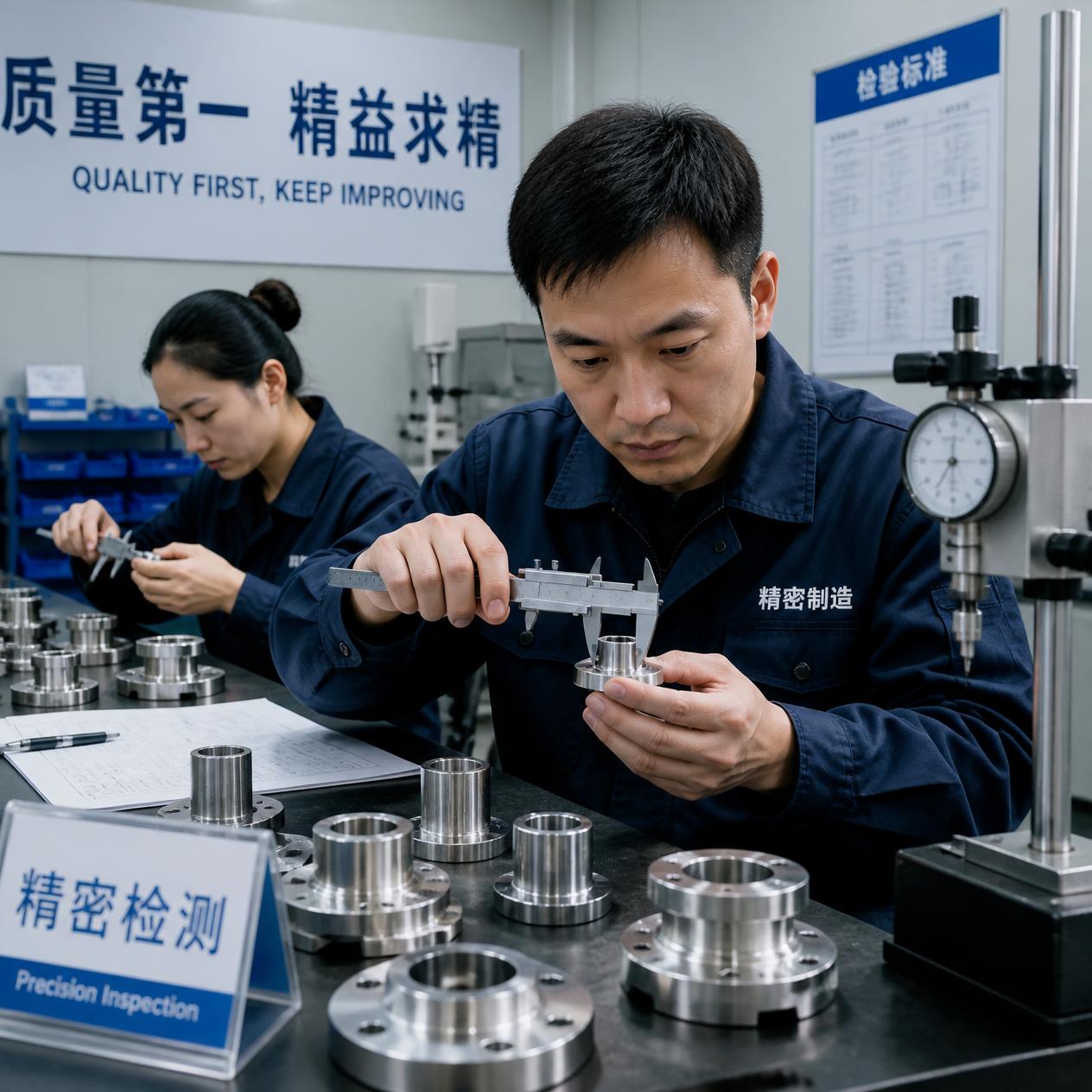
CNC Machining Design Guidelines: Key Principles for Better Parts
Designing parts for CNC machining is one of the most effective ways to improve quality, reduce cost, and shorten lead times. Even small design decisions can significantly impact manufacturability, machining time, and final part performance.
This guide outlines practical CNC machining design guidelines that help engineers and product teams create better parts. Whether you are developing prototypes or preparing for low-volume production, following these principles can lead to more efficient and reliable manufacturing outcomes.
Why CNC Design Guidelines Matter
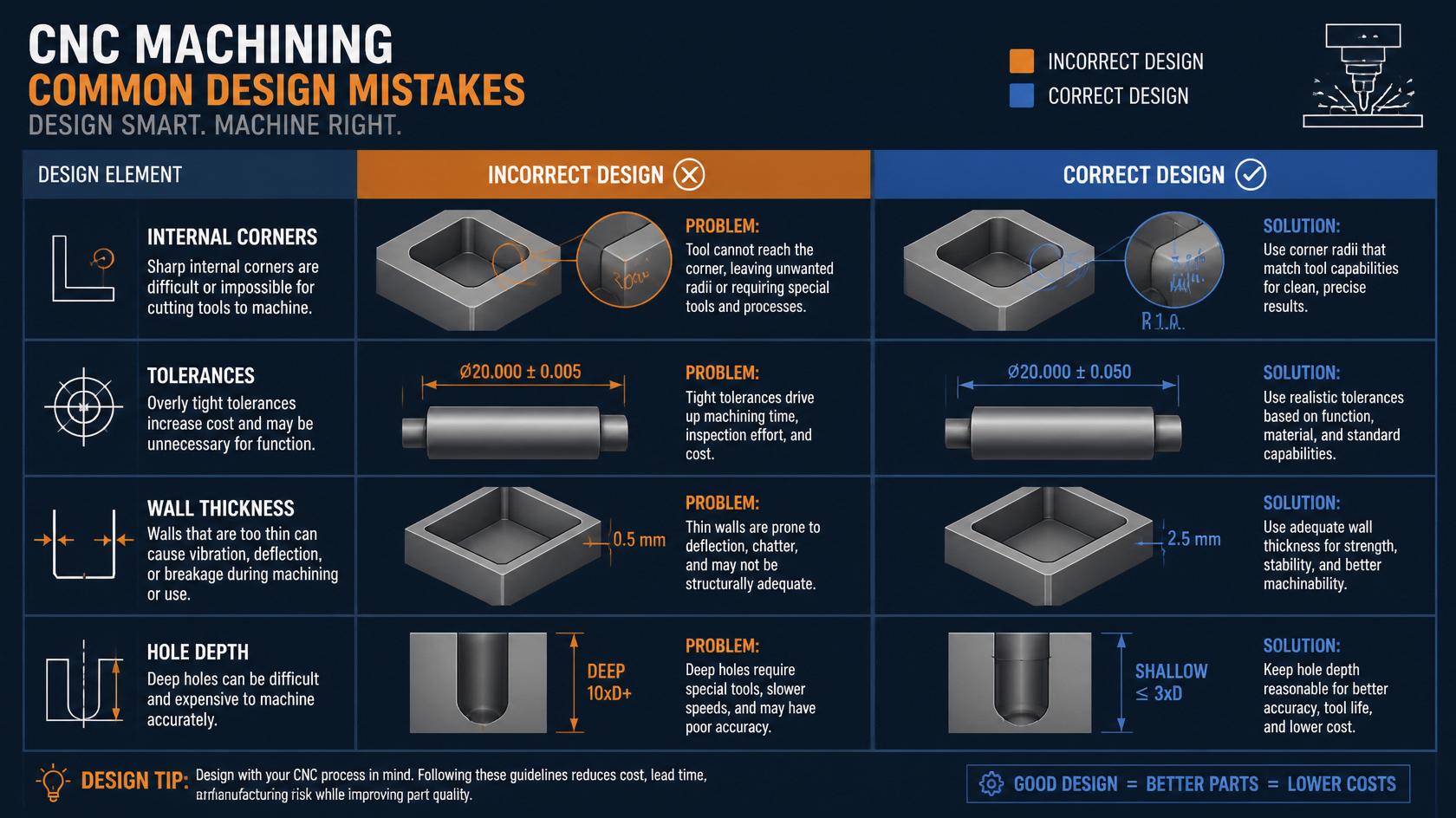
Key CNC machining design principles for improving precision, manufacturability, and part quality.
CNC machining offers excellent precision and material flexibility, but the process is still constrained by tooling, machine kinematics, part geometry, and material behavior. Designs that ignore these limitations can become more difficult and expensive to manufacture.
Poor CNC part design can result in:
- Higher machining costs
- Longer production lead times
- Increased risk of tool deflection
- Poor surface finish
- Additional setups and tooling requirements
- Unnecessary production complexity
By applying clear design guidelines early in the development process, engineers can avoid many of these problems and improve communication with their manufacturing partner.
1. Use Appropriate Internal Radii
Sharp internal corners are one of the most common design issues in CNC machining. Milling tools are round, which means they cannot create perfectly sharp internal corners. Attempting to produce very small internal radii may require smaller tools, additional machining time, or specialized processes.
Recommendations:
- Design internal corner radii equal to or larger than the selected tool radius.
- Use larger radii whenever the part function allows.
- Avoid perfectly sharp internal corners unless they are functionally necessary.
- Consider tool accessibility when designing deep internal features.
Generous internal radii allow manufacturers to use stronger cutting tools and efficient machining parameters. As a result, they can improve tool life while reducing production time and cost.
2. Maintain Proper Wall Thickness
Thin walls can create significant machining challenges. Cutting forces may cause thin sections to vibrate or deflect, which can affect dimensional accuracy and surface quality.
General Guidelines:
- Avoid extremely thin walls, especially in tall features.
- Maintain enough material thickness to provide adequate rigidity.
- Consider the relationship between wall height and wall thickness.
- Avoid sudden wall thickness changes when possible.
If thin walls are required for weight reduction or product functionality, discuss the feature with your manufacturing partner early in the design process.
3. Design Holes and Threads Thoughtfully
Holes and threaded features are common in CNC-machined components. However, unnecessary hole depths, unusual diameters, or difficult-to-access threads can increase machining complexity.
Best Practices:
- Prefer standard drill sizes whenever possible.
- Avoid excessively deep holes unless required.
- Clearly specify thread type, depth, and class of fit.
- Consider tool accessibility for drilling and threading.
- Avoid placing holes unnecessarily close to edges or other features.
Standard hole sizes and reasonable depths generally allow manufacturers to use readily available tooling, resulting in faster and more cost-effective production.
4. Apply Tolerances Strategically
Tight tolerances can increase machining time, inspection requirements, and overall manufacturing cost. Therefore, not every dimension should have the same tolerance requirement.
Recommendations:
- Apply tight tolerances only to functionally critical features.
- Use appropriate general tolerances for non-critical dimensions.
- Clearly identify important functional requirements on engineering drawings.
- Avoid adding precision that does not improve part performance.
A thoughtful tolerance strategy can improve manufacturability and cost efficiency without compromising the performance of the finished component.
5. Minimize Undercuts and Complex Features
Undercuts and complex geometries may require specialized tools, additional setups, or multi-axis machining. Although these features are sometimes necessary, unnecessary complexity should be avoided.
Design Tips:
- Minimize undercuts unless they are essential to part function.
- Simplify features that require multiple tool approaches.
- Consider whether complex features can be redesigned for standard tooling.
- Remove decorative or unnecessary geometry when it provides no functional benefit.
Reducing unnecessary complexity helps keep machining predictable while lowering setup time and manufacturing costs.
6. Consider Part Orientation and Setups
The number of setups required to manufacture a component directly affects machining time, consistency, and cost. Every time a component needs to be repositioned, additional setup and inspection may be required.
Guidelines:
- Design components that can be machined in fewer setups whenever possible.
- Avoid features that require unnecessary part reorientation.
- Consider how the workpiece will be held during machining.
- Ensure cutting tools can access critical features.
Parts that are easier to fixture and access can generally be produced more efficiently and with greater consistency.
7. Select Materials with Machinability in Mind
Material selection has a major impact on CNC machining performance. Different materials require different cutting tools, machining speeds, feeds, and cooling strategies.
Key Considerations:
- Aluminum: Many aluminum alloys offer good machinability and are widely used for CNC components.
- Stainless Steel: Provides strength and corrosion resistance but may require more demanding machining conditions.
- Engineering Plastics: Can provide lightweight and corrosion-resistant alternatives, but machining behavior varies by material.
- High-Strength Alloys: May require specialized tooling and slower machining parameters.
Choosing a material that balances functional requirements with machinability can improve both part performance and manufacturing efficiency.
Common CNC Design Mistakes to Avoid
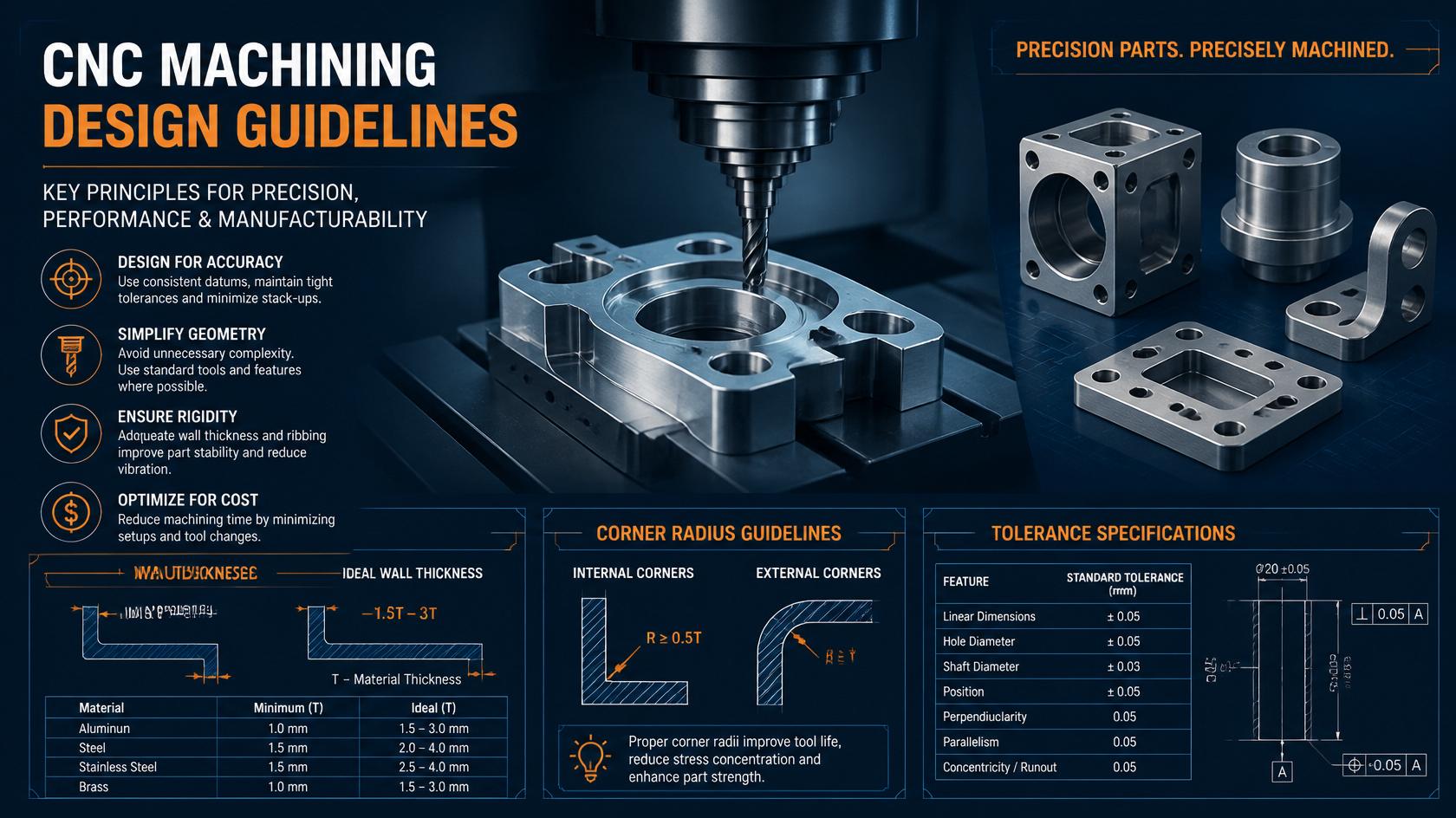
Comparison of common CNC machining design mistakes and recommended design practices.
Even a technically functional component can become expensive to manufacture if its design does not consider CNC machining requirements. Some of the most common mistakes include:
- Designing perfectly sharp internal corners
- Applying tight tolerances across the entire part
- Creating unnecessarily thin walls
- Specifying non-standard hole sizes without a functional reason
- Creating unnecessarily deep holes and pockets
- Ignoring cutting-tool accessibility
- Ignoring workholding and fixturing requirements
- Overcomplicating geometry without functional benefit
Quick CNC Design Checklist
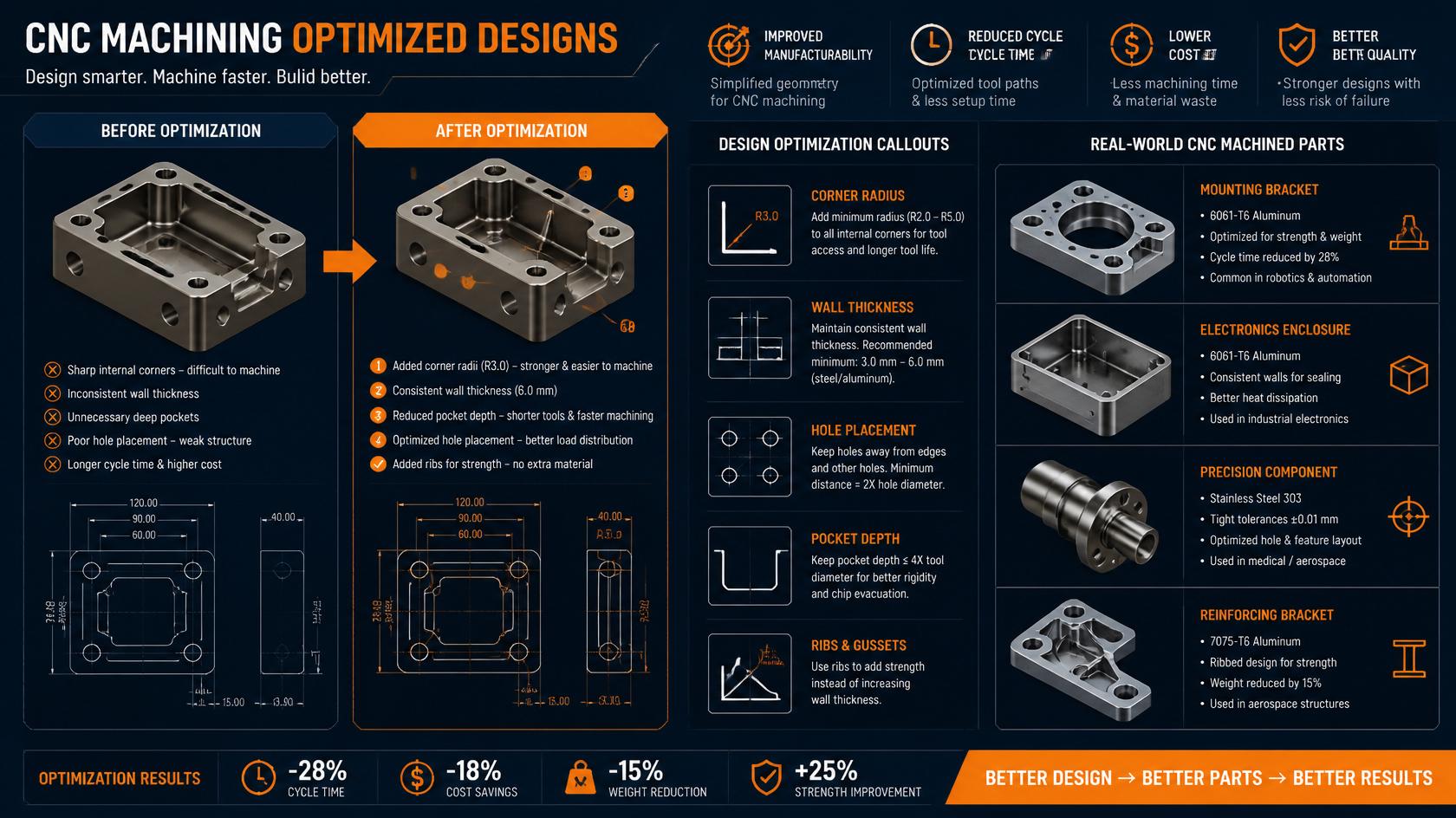
Optimized CNC part designs can improve manufacturability, reduce machining time, and control production costs.
Before finalizing your CNC part design, review the following:
- Are internal radii appropriate for standard cutting tools?
- Is wall thickness sufficient for machining stability?
- Are hole sizes and depths reasonable?
- Are standard hole and thread sizes used where possible?
- Are tight tolerances limited to critical features?
- Can cutting tools easily access all required features?
- Can the component be manufactured with minimal setups?
- Does the selected material balance function and manufacturability?
Final Thoughts
Good CNC machining outcomes start with thoughtful design. By following these CNC machining design guidelines, engineers can create components that are easier to manufacture, more consistent in quality, and more cost-efficient to produce.
Every CNC machining project has unique requirements. Considering tooling, material selection, wall thickness, internal radii, tolerances, hole design, and machining setups during the design stage can help prevent costly changes later in production.