

Sourcing precision parts from China offers clear advantages in capability, capacity, and cost. However, many buyers experience longer-than-expected lead times due to avoidable issues in communication, design readiness, and project planning.This guide outlines practical ways to reduce lead time when sourcing CNC machined parts, sheet metal components, 3D printed parts, and other precision components from China.
Why Lead Times Often Get Extended
Common causes of delay include:
- Incomplete or unclear design files
- Missing critical specifications (tolerances, materials, surface requirements)
- Multiple design revisions after production has started
- Material availability issues
- Slow communication cycles across time zones
- Choosing a process that is not well matched to the part
Most of these factors can be controlled with better preparation and clearer collaboration.
1. Submit Complete and Clear Design Files
The quality of your initial submission has a major impact on lead time.
Best practices:
- Provide complete 3D models (STEP preferred) and 2D drawings
- Clearly mark critical dimensions and tolerances
- Specify material grade, surface finish, and any special requirements
- Indicate quantity and target delivery date
Incomplete information forces suppliers to ask follow-up questions, which adds days to the process.
2. Design for Manufacturability from the Start
Parts that are difficult to machine or form require more programming time, special tooling, or additional setups.
Recommendations:
- Follow standard CNC and sheet metal design guidelines
- Avoid unnecessary tight tolerances
- Use standard hole sizes and reasonable internal radii
- Simplify features that do not affect function
A manufacturable design reduces both quotation time and production time.
3. Choose the Right Manufacturing Process Early
Selecting an unsuitable process is a frequent source of delay.
Examples:
- Using CNC machining for a part that would be faster and cheaper with sheet metal
- Moving to injection molding too early before the design is stable
- Choosing 3D printing when CNC would deliver better precision and speed for the required quantity
Discuss process options with your supplier at the beginning rather than after problems appear.
4. Confirm Material Availability
Some materials have longer procurement times than others, especially specialty alloys or less common plastics.
Tips:
- Prefer commonly available materials (e.g., Aluminum 6061, Stainless Steel 304, standard engineering plastics) when possible
- Ask your supplier about current stock or lead times for the specified material
- Be open to equivalent alternatives if they meet performance requirements
Material delays are one of the easiest lead time risks to avoid with early confirmation.
5. Minimize Design Changes After Kickoff
Every design revision after production starts can reset schedules.
How to reduce this risk:
- Finalize critical features before releasing the order
- Use prototypes to validate form, fit, and function early
- Batch non-critical changes instead of sending multiple small revisions
Stable designs move through production significantly faster.
6. Improve Communication Efficiency
Time zone differences can easily add days if communication is slow or unclear.
Effective practices:
- Provide detailed written requirements rather than relying only on short messages
- Respond to supplier questions promptly
- Use clear technical language and avoid ambiguous terms
- Confirm key decisions in writing
Clear and responsive communication shortens the overall project cycle.
7. Align Expectations on Lead Time Drivers
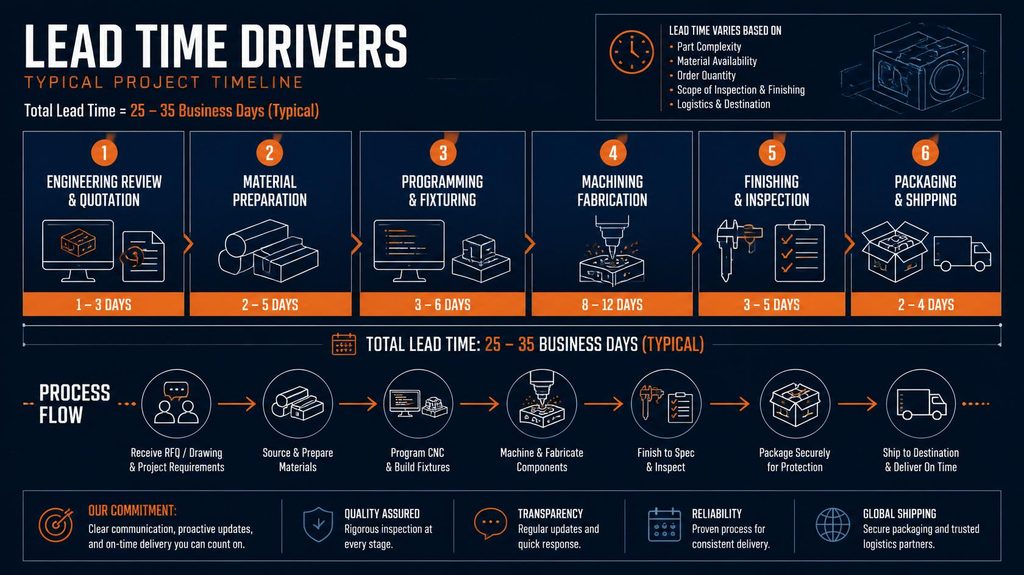
Not all lead time is production time. A typical timeline includes:
- Engineering review and quotation
- Material preparation
- Programming and fixturing
- Machining / fabrication
- Finishing and inspection
- Packaging and shipping
Understanding each stage helps you identify where time can realistically be saved.
Quick Checklist to Reduce Lead Time

Before submitting your project, review the following:
- Are design files complete and clear?
- Have critical tolerances and requirements been specified?
- Is the selected process appropriate for the part and quantity?
- Is the material commonly available?
- Is the design stable enough to avoid major revisions?
- Have you communicated target quantity and delivery needs clearly?
Final Thoughts
Reducing lead time when sourcing precision parts from China is less about pushing suppliers to work faster and more about removing friction from the process. Complete files, manufacturable designs, appropriate process selection, and clear communication deliver the largest improvements.
When these elements are handled well, many projects can move from inquiry to finished parts significantly faster and with fewer surprises.
If you are planning a project and want to optimize for shorter lead times, our engineering team can review your design and requirements and recommend the most efficient approach.
Ready to get started? Submit your project details and files, and we will provide a personalized quotation with realistic lead time guidance.