

Choosing between injection molding and CNC machining is a critical decision in product development. Both processes can produce high-quality plastic and metal parts, but they differ significantly in cost structure, lead time, design flexibility, and ideal production volume.This guide compares injection molding and CNC machining to help you select the most suitable process for your project.
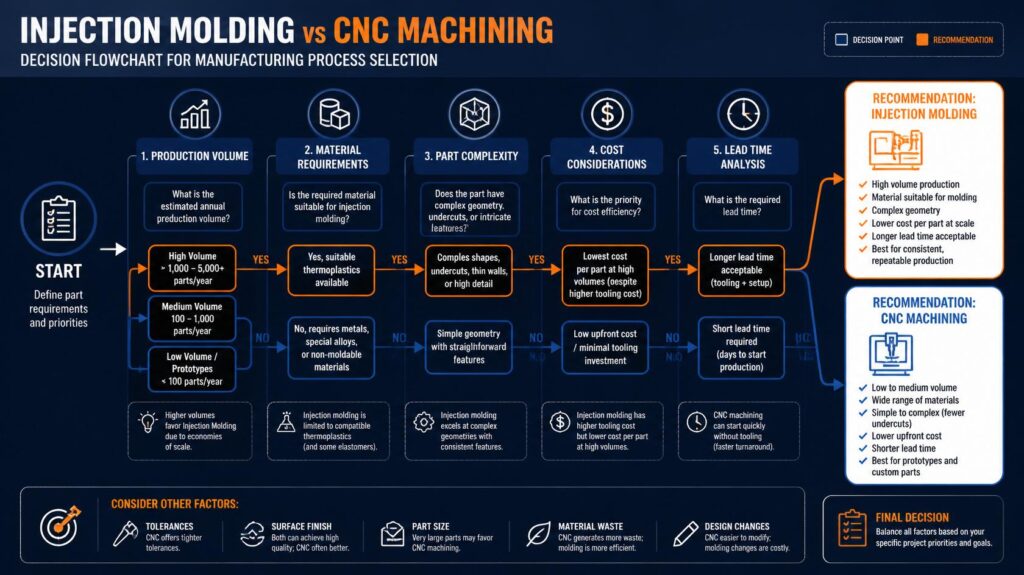
Quick Overview of Each Process
CNC Machining CNC machining is a subtractive process that removes material from solid stock using cutting tools. It is highly flexible, requires no tooling investment, and is ideal for prototypes, low-volume production, and precision parts.
Injection Molding Injection molding is a forming process that injects molten material into a mold cavity. Once the mold is made, it enables fast, consistent, and cost-effective production of identical parts at higher volumes.
Key Comparison Factors
| Factor | CNC Machining | Injection Molding |
| Process Type | Subtractive | Forming (tooling required) |
| Tooling Cost | None or minimal | High (mold investment required) |
| Unit Cost | Higher at volume | Low at medium to high volume |
| Lead Time (First Parts) | Fast (days) | Longer (weeks for tooling + production) |
| Design Flexibility | High (easy to modify) | Lower once the mold is built |
| Ideal Volume | Prototypes to low/medium volume | Medium to high volume |
| Material Options | Broad range of metals and plastics | Wide range of plastics and some elastomers |
| Tolerances | Excellent | Good to very good (depends on mold and material) |
| Surface Finish | Excellent with proper tooling | Excellent and highly consistent |
| Best For | Precision, functional prototypes, low volume | Consistent production parts at scale |
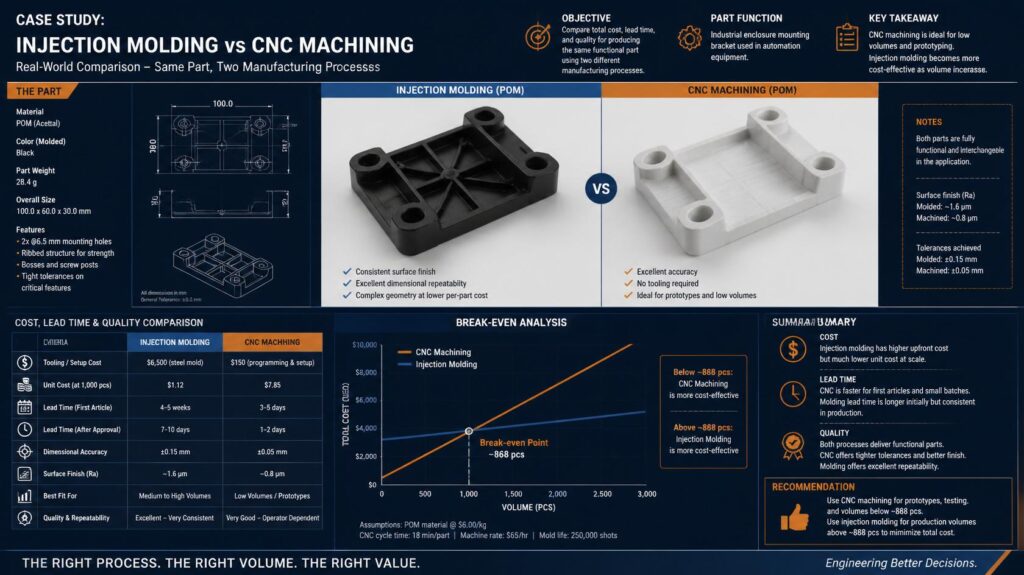
When to Choose CNC Machining
CNC machining is usually the better choice when:
- You need parts quickly No tooling is required, so first parts can often be delivered in days rather than weeks.
- Quantities are low For prototypes or small batches, CNC avoids the high upfront cost of a mold.
- Design is still changing CNC allows easy design modifications without expensive tool changes.
- Tight tolerances or complex features are required Precision CNC machining can achieve tighter tolerances and intricate details more readily in many cases.
- You need metal parts CNC is the preferred method for most metal components, while injection molding is primarily used for plastics.
Typical use cases: Functional prototypes, low-volume production, precision components, jigs and fixtures, and metal parts.
When to Choose Injection Molding
Injection molding becomes more advantageous when:
- Production volume is medium to high Once the mold is paid for, the cost per part drops significantly.
- Part consistency is critical Injection molding produces highly repeatable parts with excellent dimensional consistency.
- You are ready for production The design is finalized and unlikely to change.
- Plastic materials are suitable Many engineering plastics perform very well in injection molding and offer good strength, appearance, and cost efficiency.
- Complex plastic geometries are needed at scale Features such as ribs, bosses, and living hinges are efficiently produced in molded parts.
Typical use cases: Consumer product housings, high-volume plastic components, medical device parts, and production runs where unit cost is critical.
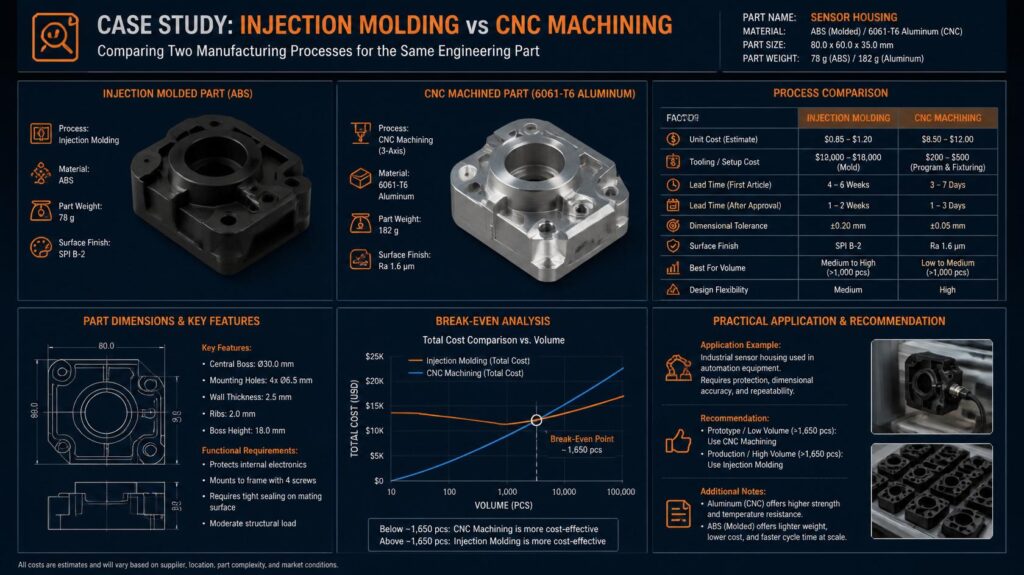
Hybrid Approach: From CNC to Injection Molding
A common and effective strategy is to use both processes at different stages:
- Start with CNC machining for prototypes and design validation.
- Refine the design based on testing and feedback.
- Transition to injection molding once the design is finalized and volume justifies the tooling investment.
This approach reduces risk, accelerates development, and ensures a smoother path to production.
Decision Checklist
Ask yourself these questions:
- How many parts do you need in the near term?
- Low quantities → CNC machining
- Higher volumes → Injection molding
- Is the design finalized?
- Still evolving → CNC machining
- Locked → Injection molding becomes viable
- Do you need metal parts?
- Yes → CNC machining
- Plastic only → Both options are possible
- How important is speed for the first parts?
- Critical → CNC machining
- Willing to wait for tooling → Injection molding
- What is your priority: flexibility or lowest unit cost at scale?
- Flexibility → CNC
- Lowest unit cost at volume → Injection molding
Final Thoughts
There is no universally superior process. CNC machining excels in speed, flexibility, and low-volume precision work, while injection molding delivers unmatched efficiency and consistency at higher volumes.
The right choice depends on your quantity, design maturity, material requirements, and cost targets. In many projects, the optimal path is to begin with CNC machining and transition to injection molding when the timing is right.
If you are unsure which process fits your project best, our engineering team can review your design and volume requirements and recommend the most practical approach.
Ready to move forward? Submit your project details and files, and we will provide a personalized recommendation and quotation.