

Aluminum Grades for CNC Machining: 6061 vs 7075 vs Others
Aluminum is one of the most widely used materials in CNC machining due to its excellent strength-to-weight ratio, good machinability, and corrosion resistance. However, not all aluminum grades perform the same. Choosing the right grade has a direct impact on part strength, cost, lead time, and manufacturability.
This guide compares the most common aluminum grades for CNC machining, with a detailed look at 6061 vs 7075 aluminum, and explains when other popular aluminum alloys may be more suitable.
Why Aluminum Is Popular for CNC Machining
Aluminum offers several advantages for precision CNC machining:
- Lightweight yet strong
- Excellent machinability, especially in certain grades
- Good corrosion resistance
- Suitable for a wide range of surface finishes
- Cost-effective compared with many high-performance metals
Because of these properties, aluminum is frequently used for prototypes, structural components, enclosures, brackets, housings, fixtures, and functional parts across industries such as aerospace, automotive, robotics, electronics, and industrial manufacturing.
Aluminum 6061 vs 7075: Key Differences
Aluminum 6061 and 7075 are two commonly specified grades for CNC machining. Understanding their differences in strength, machinability, corrosion resistance, weldability, and cost can help you select the right material for your application.
| Property | Aluminum 6061 | Aluminum 7075 |
|---|---|---|
| Strength | Good | Excellent – significantly higher |
| Machinability | Excellent | Good, but generally more challenging than 6061 |
| Corrosion Resistance | Very Good | Moderate |
| Weldability | Excellent | Limited |
| Weight | Lightweight | Lightweight |
| Cost | More Economical | Higher |
| Typical Use | General structural parts and enclosures | High-stress and high-performance parts |
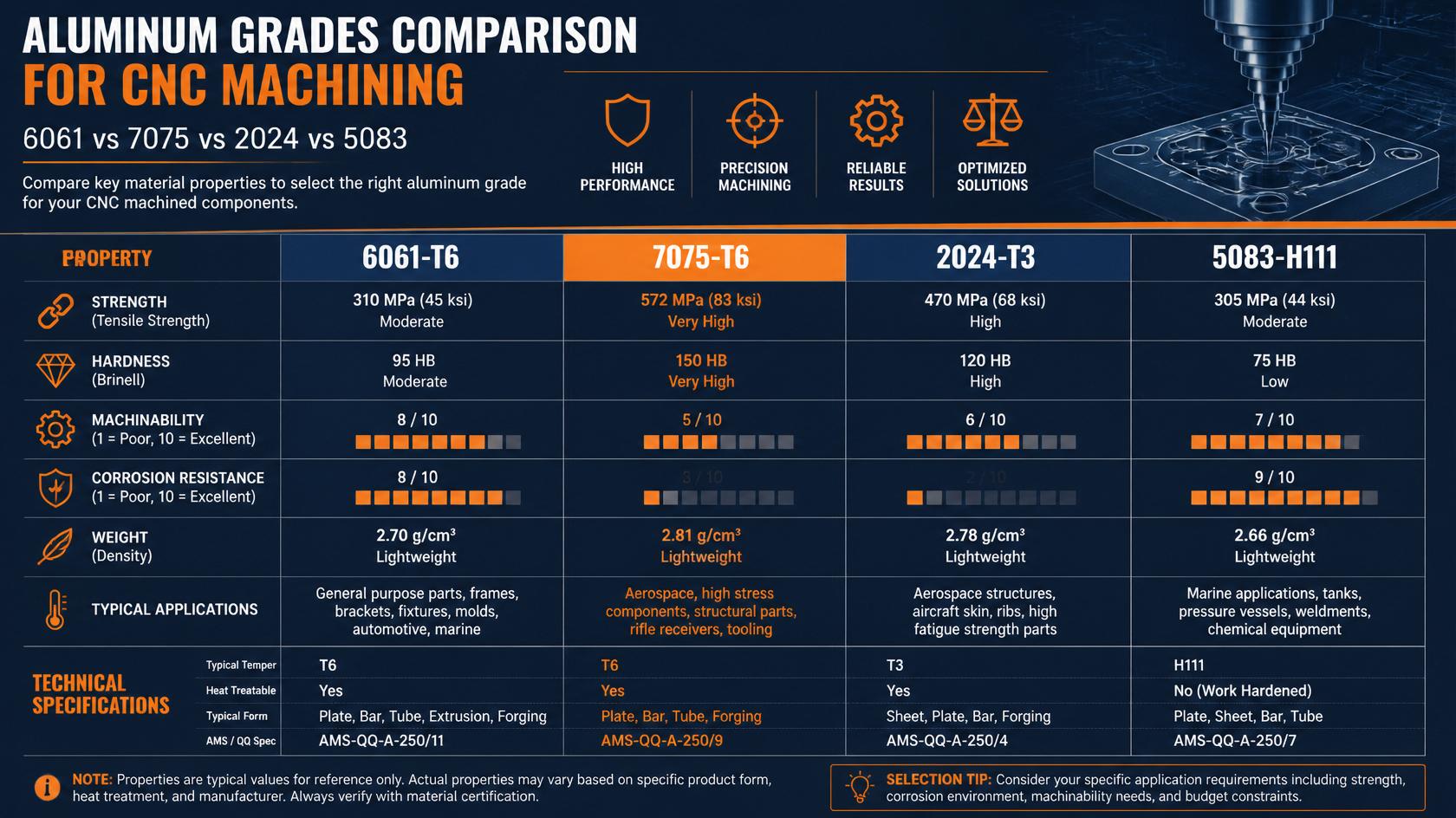
Comparison of common aluminum alloys based on strength, machinability, corrosion resistance, and typical applications.
Aluminum 6061
Aluminum 6061 is one of the most versatile and widely used aluminum alloys for CNC machining. It provides a strong balance of mechanical properties, corrosion resistance, machinability, and cost.
Best For:
- General-purpose structural components
- Enclosures and housings
- Brackets and frames
- Prototypes and low-to-medium volume production
Aluminum 7075
Aluminum 7075 is a high-strength alloy commonly selected when mechanical performance and strength are more important than cost, corrosion resistance, or weldability.
Best For:
- Aerospace components
- High-stress structural parts
- Performance-critical applications
Advantages: Very high strength and good fatigue resistance.
Considerations: Higher material cost, lower corrosion resistance than 6061, limited weldability, and generally more challenging machining.
Other Common Aluminum Grades for CNC Machining
While 6061 and 7075 cover many CNC machining applications, several other aluminum alloys are useful when projects have specialized strength, corrosion resistance, dimensional stability, or manufacturing requirements.
Aluminum 2024
- High strength and good fatigue resistance
- Commonly used in aerospace applications
- Lower corrosion resistance than 6061
- Generally more challenging to machine than 6061
Aluminum 5052
- Excellent corrosion resistance, particularly in marine environments
- Good formability
- Lower strength compared with 6061 and 7075
- Often used for sheet metal applications but can also be machined
Aluminum 6082
- Similar to 6061 with slightly higher strength in some conditions
- Good corrosion resistance
- Good machinability
- Commonly used in structural applications, particularly in Europe
Aluminum MIC-6 (Cast Aluminum Tooling Plate)
- Excellent dimensional stability
- Very good flatness and machinability
- Ideal for precision base plates, fixtures, and tooling
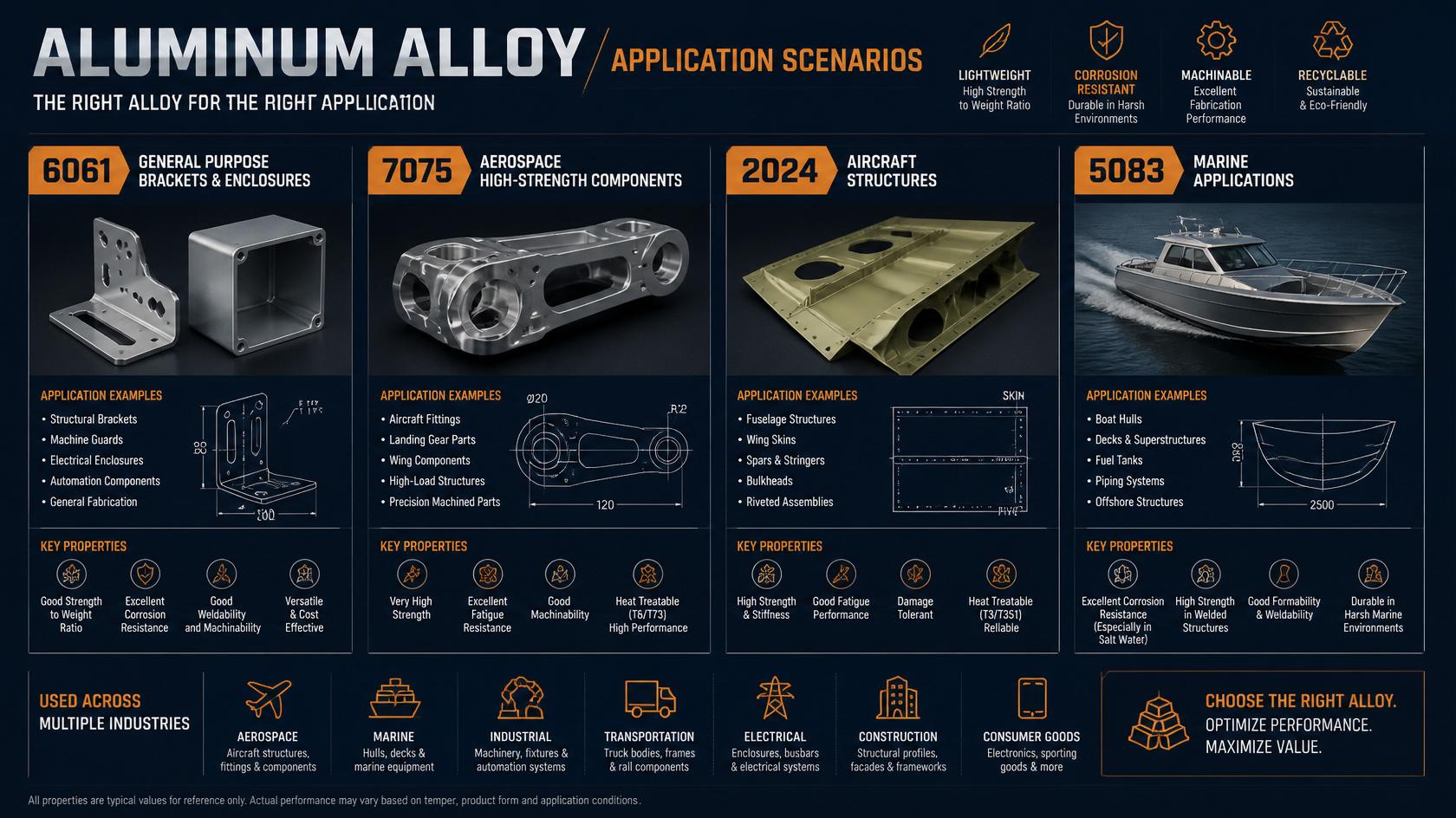
Typical application scenarios for aluminum alloys across general engineering, aerospace, aircraft, and marine industries.
How to Choose the Right Aluminum Grade
Use the following guidelines when selecting aluminum for your CNC machining project.
Choose 6061 if:
- You need a balance of strength, machinability, and cost.
- Corrosion resistance is important.
- Your part is a general structural or enclosure component.
Choose 7075 if:
- Maximum strength is required.
- The part will experience high stress or fatigue.
- You are developing aerospace or high-performance components.
Consider Other Grades if:
- You need superior corrosion resistance – consider 5052.
- Dimensional stability is critical – consider MIC-6.
- Specific industry or regional requirements apply – consider 6082 or 2024 where appropriate.
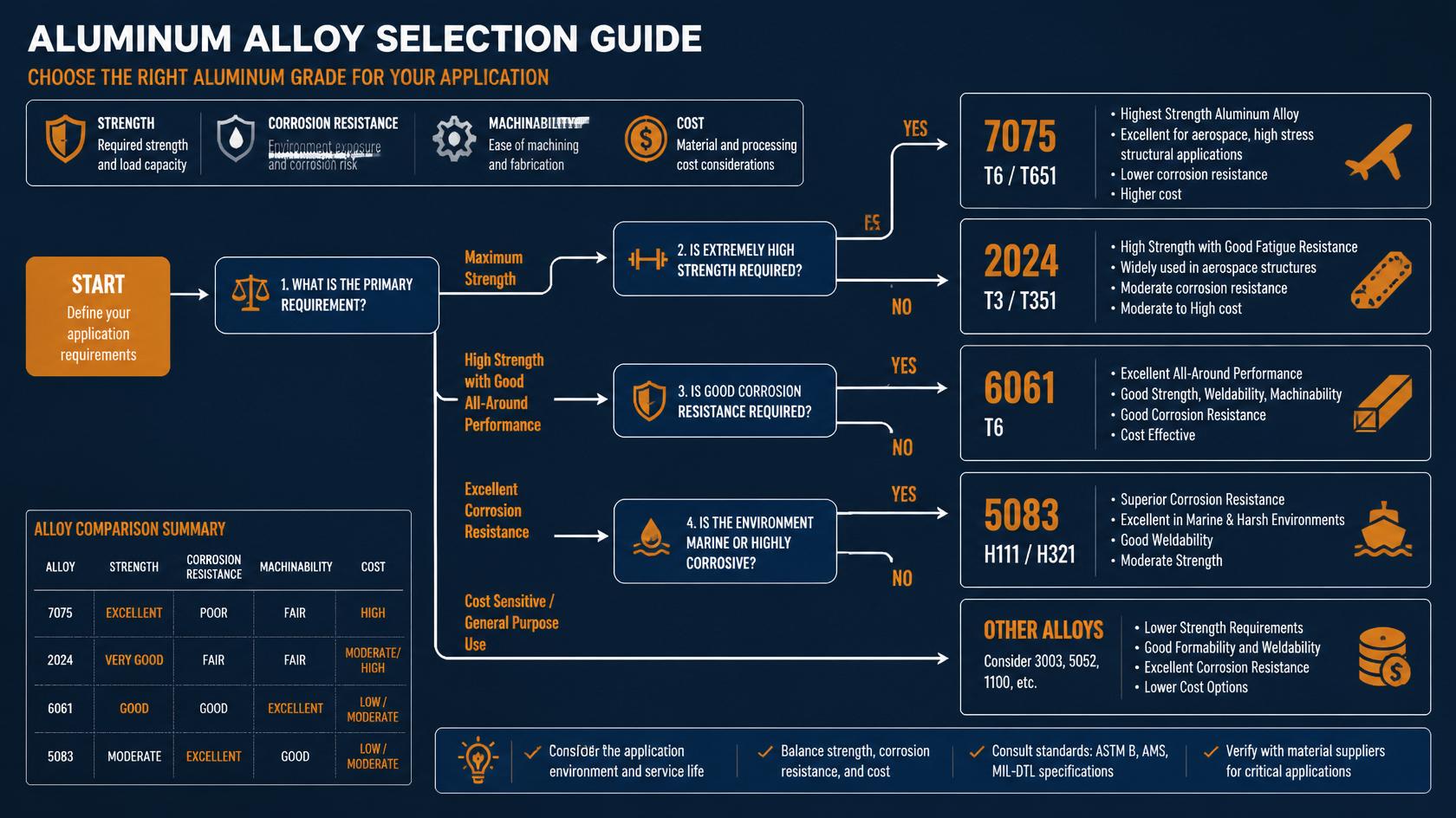
Aluminum alloy selection guide based on strength, corrosion resistance, machinability, application, and cost.
Quick Aluminum Grade Selection Guide
| Application Need | Recommended Grade |
|---|---|
| General CNC parts & prototypes | 6061 |
| High-strength structural parts | 7075 |
| Aerospace components | 7075 or 2024 |
| Excellent corrosion resistance | 6061 or 5052 |
| Precision fixtures & base plates | MIC-6 |
| Cost-sensitive projects | 6061 |
Final Thoughts
Selecting the right aluminum grade is an important step in CNC machining. Aluminum 6061 remains a versatile and cost-effective choice for many projects, while 7075 is often selected when high strength and performance are essential.
Other aluminum grades such as 2024, 5052, 6082, and MIC-6 serve more specialized requirements. Your final material selection should consider strength, corrosion resistance, machinability, dimensional stability, surface finish, cost, and the operating environment.
If you are unsure which aluminum grade is best for your part, our engineering team can review your design and performance requirements and recommend a suitable material.
