

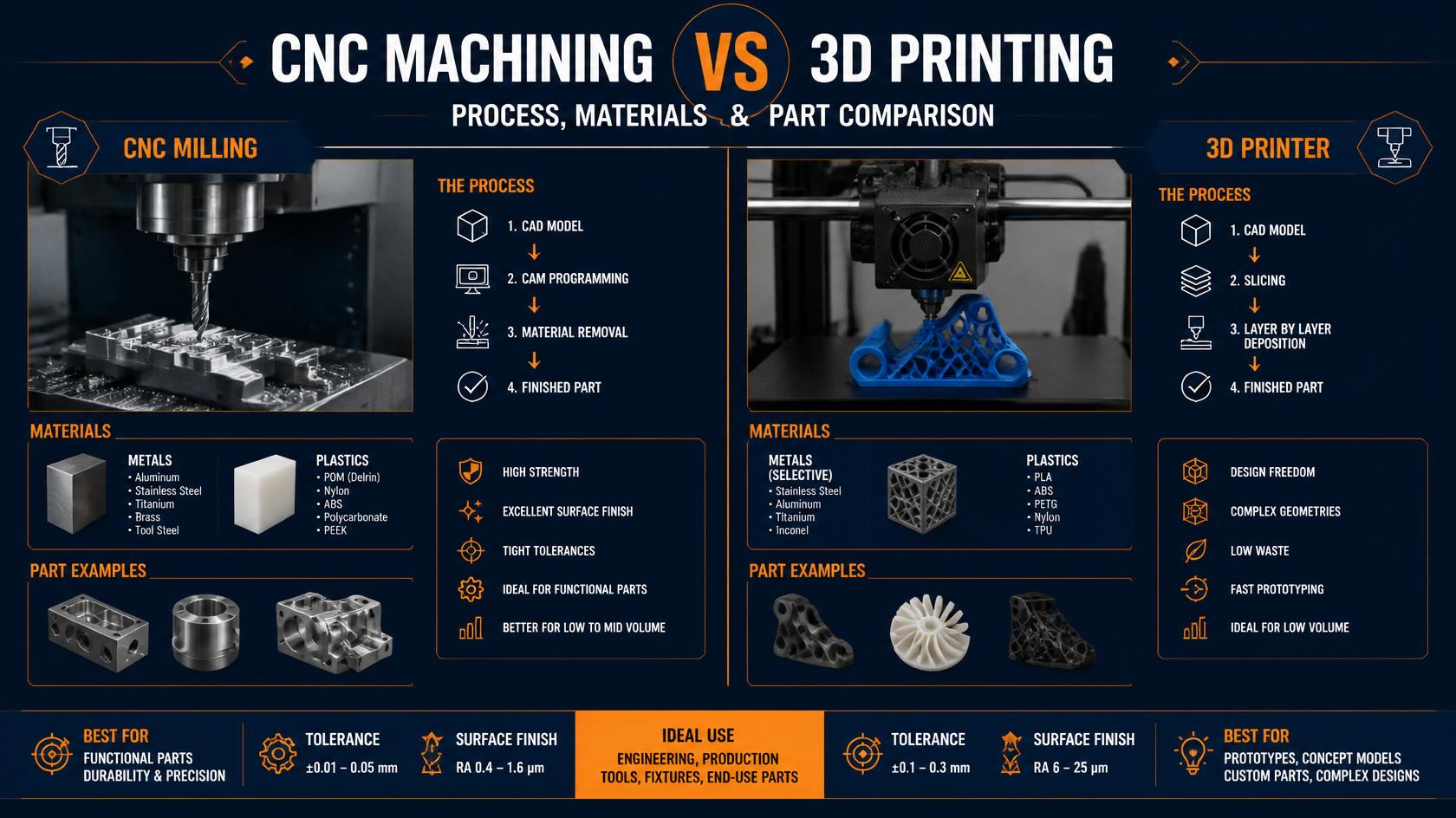
How to Choose Between CNC Machining and 3D Printing
Choosing between CNC machining and 3D printing is a common decision in product development. Both processes are widely used for prototypes and production parts, but they differ significantly in capabilities, cost structure, lead time, and design freedom.
This guide explains the key differences between CNC machining and 3D printing and helps you decide which manufacturing process is better suited for your project.
Quick Overview of Each Process
CNC Machining
CNC machining is a subtractive manufacturing process that removes material from a solid block using cutting tools. It is well suited for high-precision parts, strong functional components, and a wide range of engineering materials.
3D Printing (Additive Manufacturing)
3D printing is an additive manufacturing process that builds parts layer by layer from digital files. It excels at complex geometries, rapid iteration, and low-volume custom parts that may be difficult or expensive to machine.
Key Comparison Factors
CNC machining and 3D printing offer different advantages. Comparing the most important manufacturing factors can help determine which process is more suitable for your part.
| Factor | CNC Machining | 3D Printing |
|---|---|---|
| Process Type | Subtractive | Additive |
| Design Freedom | Moderate, limited by tooling access | High, including complex internal features |
| Precision & Tolerances | Excellent; tight tolerances achievable | Good to moderate; process-dependent |
| Material Options | Broad range of metals and plastics | Growing range, but process-dependent |
| Strength & Performance | High, based on solid stock material | Varies by technology and material |
| Surface Finish | Excellent with appropriate tooling | May require post-processing |
| Best Volume Range | Prototypes to low/medium volume | Prototypes and very low volume |
| Lead Time | Fast for simple parts; longer for complex parts | Very fast for many prototype geometries |
| Cost Driver | Machining time, setups, tooling, and material | Build time, material, and support structures |
When to Choose CNC Machining
CNC machining is usually the better choice when:
Tight Tolerances Are Required
Precision CNC machining can consistently achieve tight dimensional accuracy that many 3D printing processes cannot match. This makes CNC machining suitable for precision components and parts that must fit accurately within an assembly.
High Mechanical Strength Is Critical
Machined parts use solid stock material and are well suited for functional and load-bearing components where mechanical performance is important.
You Need Excellent Surface Finish
CNC machining can produce high-quality as-machined surfaces. Additional finishing processes can also be applied when a specific appearance or surface requirement is needed.
You Are Using Engineering Metals
Aluminum, stainless steel, titanium, and many other engineering metals can be processed using CNC machining, depending on part requirements and machine capability.
The Design Is Relatively Straightforward
Parts without extreme internal complexity or difficult organic shapes can often be manufactured efficiently using CNC machining.
Typical CNC machining use cases: Functional prototypes, precision components, jigs and fixtures, low-volume production parts, and end-use metal components.
When to Choose 3D Printing
3D printing is often the better option when:
Geometry Is Highly Complex
Internal channels, lattice structures, organic shapes, and other complex geometries that may be difficult to machine can be well suited to additive manufacturing.
Speed of Iteration Is the Priority
3D printing allows product teams to make rapid design changes without requiring traditional tooling or complex fixturing for every design iteration.
Low Quantities Are Needed
For one-off components and very small batches, 3D printing can be an economical solution, particularly during early product development.
Lightweight or Optimized Structures Are Required
Additive manufacturing can enable lattice structures, topology-optimized designs, and other lightweight geometries that may be challenging to produce through conventional machining.
You Are Still in Early Development
Concept models and early-stage prototypes can benefit from the speed and flexibility of 3D printing, allowing teams to evaluate designs before committing to final manufacturing.
Typical 3D printing use cases: Concept models, complex prototypes, custom fixtures, very low-volume parts, and designs containing complex internal features.
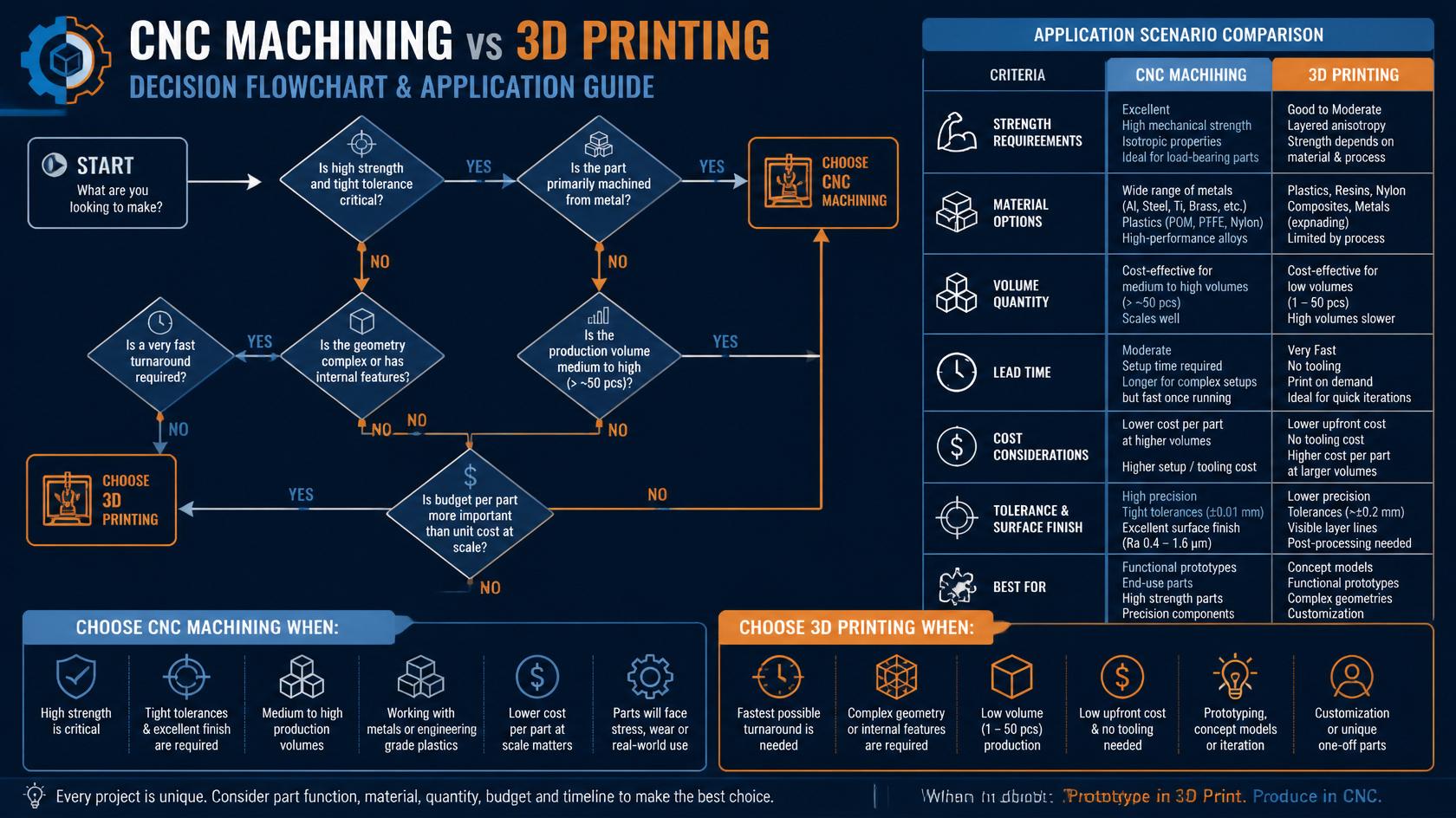
Decision guide for selecting CNC machining or 3D printing based on part requirements, geometry, material, quantity, cost, and lead time.
Hybrid Approach: Using Both Processes
In many projects, the best manufacturing strategy is not to choose one process exclusively. CNC machining and 3D printing can complement each other during different stages of product development.
A common approach is:
- Use 3D printing for early design validation and rapid iteration.
- Transition to CNC machining for functional prototypes and production parts that require higher precision, strength, or improved surface quality.
This hybrid strategy can reduce development risk while helping ensure final parts meet functional and performance requirements.
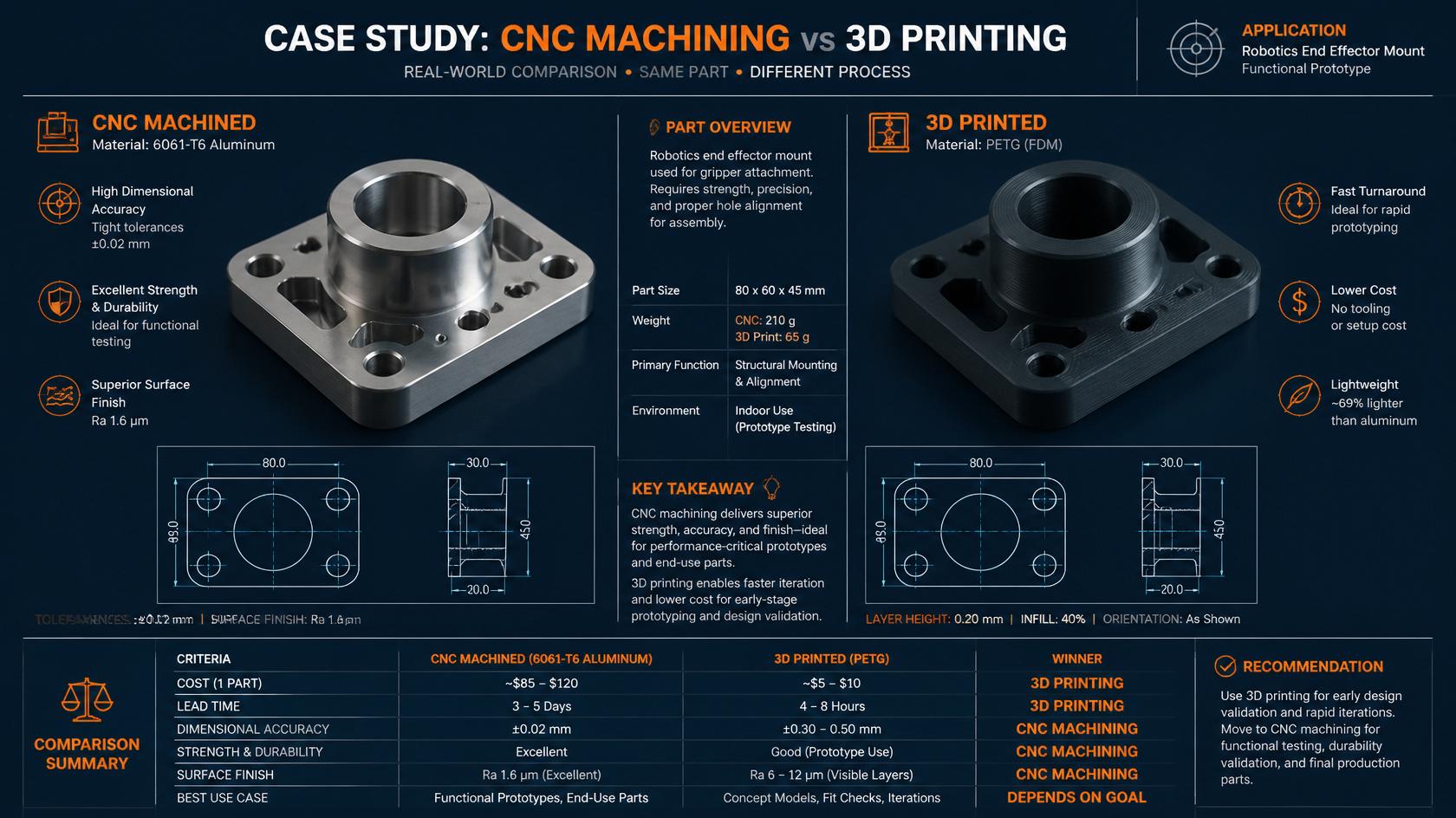
Real-world comparison of CNC machining and 3D printing for functional prototype development.
Decision Checklist
Before choosing a manufacturing process, ask yourself the following questions:
- Does the part require tight tolerances or high mechanical strength? Consider CNC machining.
- Is the geometry highly complex or organic? Consider 3D printing.
- Do you need only a small number of complex prototype parts? 3D printing may be more practical.
- Do you need functional or higher-precision parts? CNC machining may be more suitable.
- Does the application require engineering metals with strong material properties? Consider CNC machining.
- Does the design contain complex plastic geometries or internal structures? Consider 3D printing.
- Is surface finish critical? CNC machining generally provides greater control over machined surface quality.
CNC Machining or 3D Printing: Which Should You Choose?
| Your Requirement | Recommended Process |
|---|---|
| Tight tolerances | CNC Machining |
| Complex internal geometry | 3D Printing |
| High mechanical strength | CNC Machining |
| Rapid design iteration | 3D Printing |
| Engineering metal components | CNC Machining |
| Early-stage concept models | 3D Printing |
| Functional prototypes | CNC Machining / Depends on requirements |
Final Thoughts
There is no universal winner when comparing CNC machining vs 3D printing. Both manufacturing processes have clear strengths. The right choice depends on your part geometry, material requirements, tolerance needs, production quantity, surface finish requirements, budget, and development stage.
CNC machining is generally well suited for strong, precise, functional components, particularly when engineering materials and controlled tolerances are important. In contrast, 3D printing can provide significant advantages for rapid prototyping, complex geometries, design iteration, and very low-volume production.
If you are unsure which manufacturing process is more suitable for your project, our engineering team can review your design requirements and recommend a practical manufacturing approach.
